
SMDx Detect p-Tau205
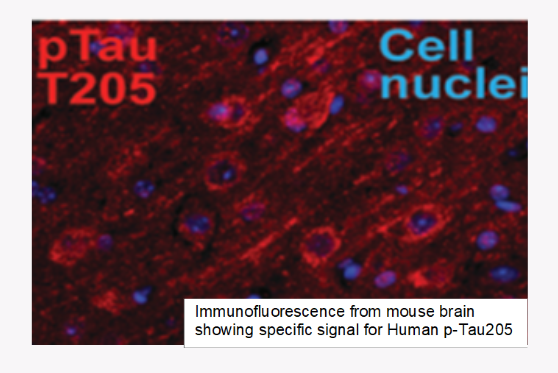
The SMDx Detect p-Tau205 antibody is a high-performance proprietary monoclonal antibody developed specifically for the detection of p-Tau205 (Tau protein phosphorylated at Threonine 205) in biological fluid and tissue.
Recent research highlights p-Tau205 as an accessible alternative to Tau PET in clinical settings and clinical trials.1 p-Tau205 has also shown promise in AD disease staging and guiding clinical decisions.2 Unlike earlier tau biomarkers like p-Tau 181 and p-Tau217 which are primarily associated with amyloid co-pathology and early tau accumulation, p-Tau205 is the only tau phosphoepitope demonstrated to be better associated with tau PET than with amyloid PET making it uniquely specific marker of Tau pathology independent of amyloid co-pathology.3
Phosphorylation at Threonine 205 is the same epitope recognized by the established AT8 antibody used in post-mortem staging of Alzheimer’s disease neurofibrillary pathology; meaning p-Tau 205 quantification represents the same neuropathological substrate used as a historical gold standard for AD staging.1
The SMDx Detect p-Tau205 antibody delivers high sensitivity and specificity for the Thr205 epitope enabling robust signal detection in low abundance biological fluid matrices on ultra-sensitive immunoassay platforms and mass spectrometry workflows. In head-to-head comparisons the SMDx Detect p-Tau205 antibody has demonstrated superior performance relative to commercially available offerings with improved signal to noise ratio and greater dynamic range across disease severity stages positioning it as the antibody of choice for next generation p-Tau205 assay development.

Ordering information
p-Tau205 is the only blood-based tau biomarker demonstrated to correlate more strongly with tau PET than with amyloid PET1, making it complementary and non-redundant with Core 1 biomarkers such as p-Tau217
Classified as a Core 2 biomarker in the 2024 Alzheimer’s Association revised diagnostic framework (Jack et al. 2024), reflecting its established role in Tau proteinopathy staging
p-tau205 has an increased dynamic range compared to p-Tau217 in predicting symptom onset and severity, enabling more precise stratification of patients across the MCI-to-dementia spectrum1
p-Tau205 increases progressively across the full AD continuum from cognitively unimpaired amyloid-positive individuals through to advanced dementia, supporting longitudinal monitoring and clinical trial enrichment1
CSF p-Tau205 displays the strongest associations with Tau-PET specifically in Braak V–VI regions1, making it the preferred biomarker for detecting and staging advanced neurofibrillary pathology
p-Tau205 correlates significantly with cognitive performance measures (rSp = −0.38 to −0.40), supporting its use as a surrogate endpoint in disease-modifying therapy trials1
p-Tau205 phosphorylation is associated with loss of white matter integrity in autosomal dominant AD, providing additional sensitivity to structural neurodegeneration beyond grey matter atrophy
The SMarT Minds Dx proprietary antibody outperforms commercial offerings in signal-to-noise ratio, dynamic range, and matrix tolerance in plasma, enabling reliable detection at sub-picomolar concentrations
Compatible for use on Simoa HD-X and NULISATM platforms; suitable for adaptation to automated immunoassay platforms for clinical laboratory deployment
A high-throughput p-Tau205 immunoassay represents a potentially cost-effective alternative to tau PET in clinical settings and clinical trials1, with applications spanning diagnostics, clinical trial patient selection, treatment response monitoring, and disease staging
References
1 Lantero-Rodriguez, J., Montoliu-Gaya, L., Benedet, A.L., Vrillon, A., Dumurgier, J., Cognat, E., Brum, W.S., Rahmouni, N., Stevenson, J., Servaes, S. and Therriault, J., 2024. CSF p-tau205: a biomarker of tau pathology in Alzheimer’s disease. Acta Neuropathologica, 147(1), p.12.
2 Montoliu-Gaya, L., Salvadó, G., Therriault, J., Nilsson, J., Janelidze, S., Weiner, S., Ashton, N.J., Benedet, A.L., Rahmouni, N., Lantero-Rodriguez, J. and Mattsson-Carlgren, N., 2025. Plasma tau biomarkers for biological staging of Alzheimer’s disease. Nature Aging, 5(11), pp.2297-2308.
3 Barthélemy, N.R., Saef, B., Li, Y., Gordon, B.A., He, Y., Horie, K., Stomrud, E., Salvadó, G., Janelidze, S., Sato, C. and Ovod, V., 2023. CSF tau phosphorylation occupancies at T217 and T205 represent improved biomarkers of amyloid and tau pathology in Alzheimer’s disease. Nature aging, 3(4), pp.391-401.